 |
It's Book Fair Week!! Students can bring money to buy books all week.
Resources this week:
Cox -
Tuesday - Music
Wednesday - Media/P.E.
Thursday - Art
Townsend -
Tuesday - P.E.
Wednesday - Art
ELA:
This week in reading we will continue
to work on reading the text closely, getting the gist (what the story is mainly
about) and finding unfamiliar vocabulary. For homework, students are to be
working on their designated computer program (Achieve or I-ready Reading),
based on their reading level. If they go on Achieve, they must pass at least
two articles with a 75% or higher and for the students going on I-ready
reading, they must go on for at least 45 minutes each week and get at least two
lessons with scores of 100%. Spelling words were written down in the student’s
planners on Friday (they were also posted on Class Dojo on Wednesday), please
make sure your child is practicing and studying these words each night. I have
provided the “Spelling Menu” for various ways your child can study these words.
Their spelling test will be on Friday. Until the book logs are ready, students
will be recording their reading in their planners. They must be reading at
least 25 minutes each night. Thank you for your continued support in helping your
child be a more successful reader! ~Mrs. Townsend
Math:
This week in
math, we will continue to work on understanding the meaning of the unknown as
the number of groups in division and interpreting the unknown in division using
the array model. The students will study
the commutative property of multiplication by manipulating arrays. They will notice that the meaning of the
factors in a multiplication sentence changes depending on the orientation of
the array. We will begin to introduce the distributive property as a strategy
for multiplication. The students will
use arrays to decompose unknown facts as the sum or difference of two known
facts.
For
example:
This array has 3 rows (rows are horizontal) and 5 columns (vertical). This is a 3 by 5 array.
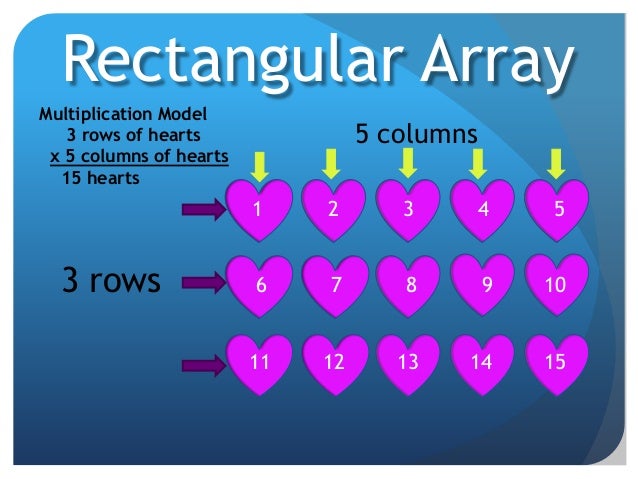
The array can be rotated to
show 5 rows of 3 or 5 by 3.
The array can be used to model
division. The problem will determine
which way to draw the array.
For
example:
Bob has 15 star stickers. He puts them into 3 boxes. How many stickers will be in each box?
15 ÷ 3
= 5
There
will be 5 stickers in each box.
Example of decomposing an array
and using the distributive property of multiplication:

Math Vocabulary:
Array – an arrangement
of objects into equal rows and columns
Multiply - an operation showing how many
times a number is added to itself
Equal groups – same number of objects in each
group
Factor – number of groups and the number in each
group
Equation – a statement that two
expressions are equal, for example 4 x 3 = 12
Divide – separate into equal groups
Things
to do at home:
Practice making arrays at home. Talk about changing the orientation of your
arrays and write the multiplication equation.
Create your own multiplication and division word problems
and write the equations for the problems.
Look for groups of things at home.
Practice multiplication facts.
Science:
This week in science we will continue to learn about the
”Scientific Method” and learn about tools scientists use when they are making
observations and performing experiments.

